
Turn Your Capital into Cash Flow
Estimate how much funding may be available from your property while continuing to live in your home. Compare repayment options before speaking with an advisor.
How much could you release?
Enter your property and loan details below.
This calculator provides an estimate only. Final terms depend on property valuation, lender approval, legal structure, age, income, tax position, interest rate, and risk assessment.

Who can choose to Seller Fund?
Property owners who currently hold 100% equity in their properties and are mortgage-free, as well as sellers with low mortgages representing less than 20% of the property’s value.
Property owners looking to sell and rent back for less than the mortgage repayments.
What is Seller Funding?
Seller funding occurs when the seller provides financing directly to the buyer, rather than the buyer relying on a traditional bank loan. After an initial deposit is paid, the buyer repays the seller according to agreed loan terms. In this scenario, the seller acts as the lender and receives ongoing principal and interest payments as income.
This arrangement can make a property more marketable by attracting a wider range of potential buyers. We recommend that seller funding only be advanced on a first mortgage basis and for no more than 75% to 80% of the sale price.
Our legal advisers will prepare all necessary documentation at our cost for your lawyers to review and approve.

What is a Reverse Mortgage?
A reverse mortgage allows you to borrow against the equity in your home, provided you are mortgage-free or can pay off your existing mortgage with the new loan.
Regular repayments are optional, as interest is calculated on the outstanding balance and added to the loan monthly. However, you may make voluntary repayments at any time to reduce the balance and interest charges. The total loan amount, including accumulated interest, is only repayable when you permanently move from your home, such as when you sell the property, move into long-term care, or pass away.
To be eligible, you must be over the age of 60 and own your home outright or have enough equity to clear your current mortgage. The amount you can access depends on your age and property value; for example, at age 60, you are typically eligible for 20% of the home’s value.
How It Works in 5 Easy Steps
Prepare your property details, photos, pricing, and key selling points, then publish the listing to attract serious potential buyers quickly.
Prepare clear loan agreements, repayment terms, security documents, and solicitor-reviewed paperwork to protect both seller and buyer throughout the process.
Review the buyer, property condition, builder’s report, credit checks, and legal risks before approving the vendor funding arrangement for settlement.
Complete settlement, transfer agreed ownership terms, activate the repayment schedule, and begin receiving structured monthly payments from the buyer securely.
Review the buyer, property condition, builder’s report, credit checks, and legal risks before approving the Seller funding arrangement for settlement.
Reverse Mortgage vs Seller Funding
Reverse Mortgage
- Borrow against your home equity without selling.
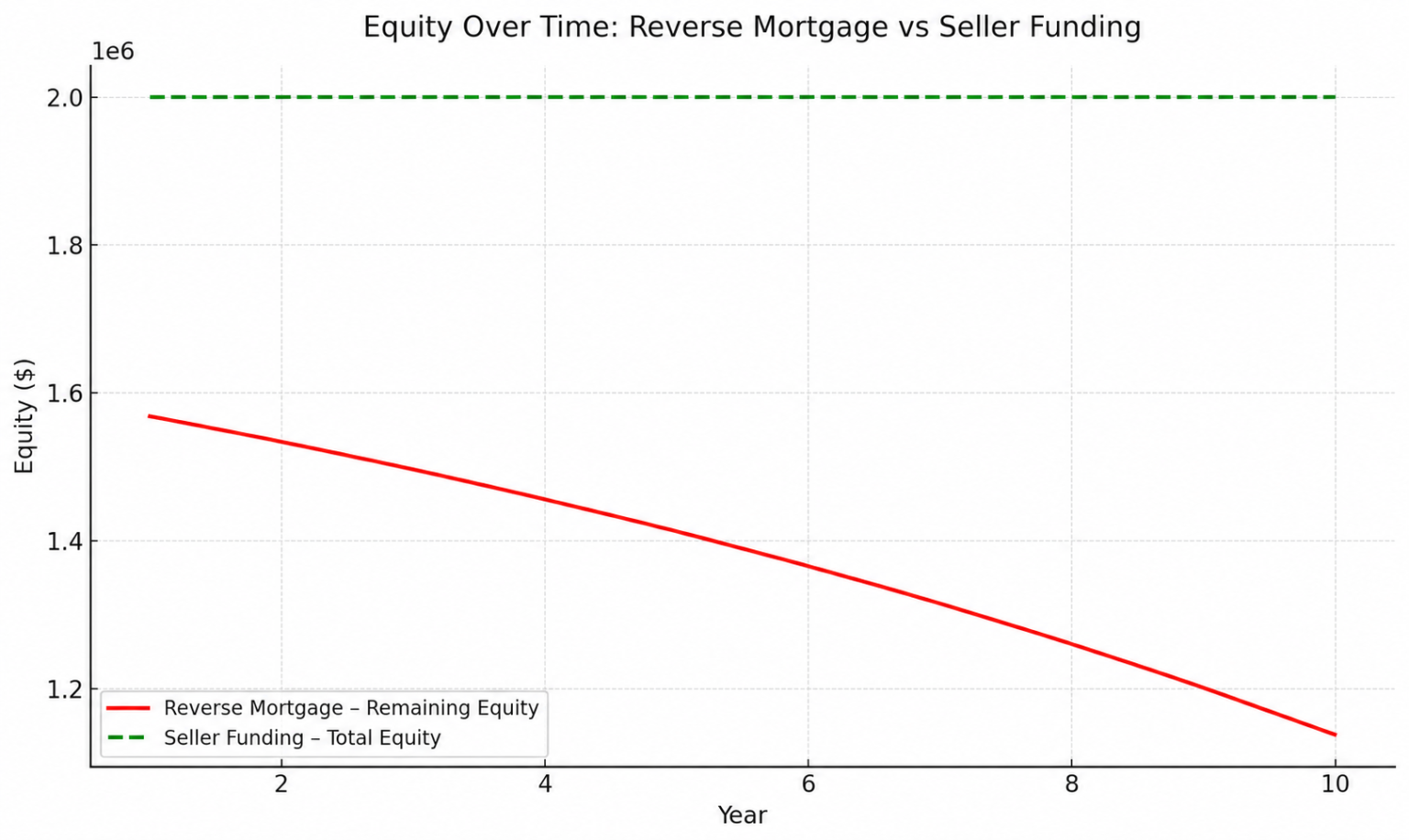
- Interest compounds over time, reducing equity.
- No compulsory repayments until the property is sold or the owner passes away.
Seller Funding
- Sell your property and finance the buyer’s purchase.
- Earn interest income, for example 5% per year, on the loaned portion.
- Ownership transfers to the buyer, but you retain a mortgage-secured income stream.
| Aspect | Reverse Mortgage | Seller Funding |
|---|---|---|
| Access to Cash | Quick access to funds without selling | Immediate deposit + ongoing income |
| Ownership | You retain ownership | Ownership transfers to buyer |
| Cashflow | No repayments, no income | Regular interest oncome and capital payments |
| Risk | Interest compounds rapidly | Risk if buyer defaults offset by priority on the loan (Refer FAQ’s) |
| Inheritance | Reduces estate value | Estate receives Loan Principal and/or ongoing mortgage payments |
| Compliance | Regulated under CCCFA | Private loan, solicitor drafted |
What do the numbers look like
| Aspect | Reverse Mortgage | Seller Funding |
|---|---|---|
| Starting Amount | $400,000 borrowed | $1,600,000 Seller Funding * |
| Interest Rate | 7.99% | 5.00% |
| Duration | 10 years | 1 to 30 Years (Negotiable) |
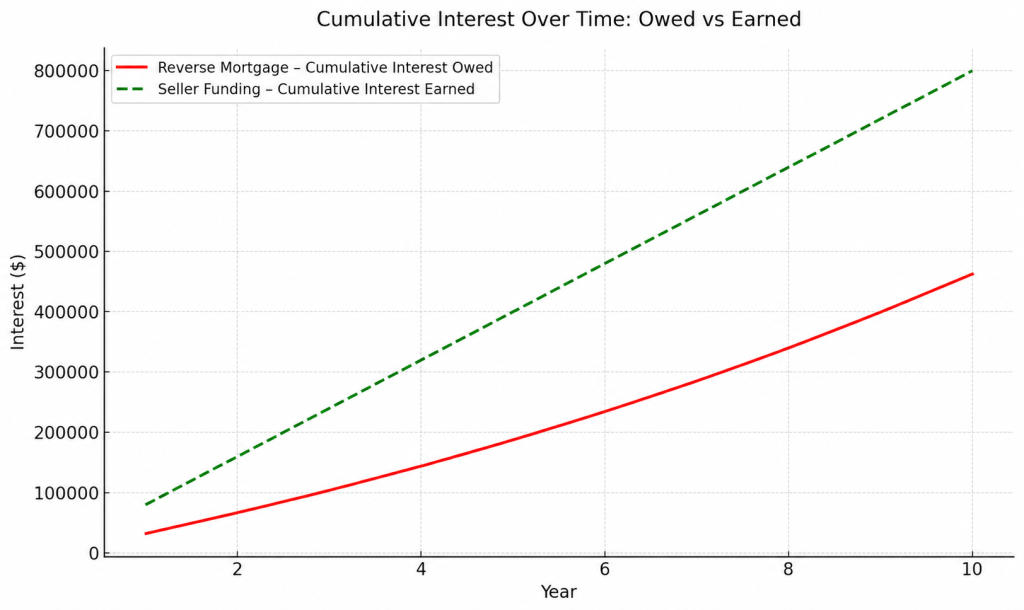
| Annual Cashflow | $0 | $80,000 income |
| Total Return / Owing | $862,771 owed | $800,000 earned |
| Equity After 10 Years | $1.14M (down from $2M) | $2.0M (retained) |
Figures are based on a $2 million dollar property with $400,000 deposit or reverse mortgage of $400,000
Got Questions?
Providing seller finance as a private individual selling your own property will not usually make you a financial institution, provided it is a one-off arrangement and not part of a regular lending business.
This means you would generally avoid the extensive regulatory obligations that apply to banks or licensed lenders. However, the arrangement must still be properly documented and structured to comply with relevant New Zealand property, credit, and contract law requirements, including fair and transparent loan terms.
We have documentation prepared by an experienced lawyer. We recommend that your solicitor reviews the structure and either advises on our documentation or prepares the mortgage documentation based on the terms agreed in the Agreement for Sale and Purchase.
Seller finance can still allow flexibility if you need to purchase another property or downsize.
You may be able to access capital by assigning the mortgage to a third party, using it as security to borrow against, or arranging bridging finance through a bank. This can help you move forward without disrupting the original vendor finance arrangement.
In many cases, the deposit received from the buyer can be used toward the purchase of your next property. The monthly interest payments received in advance may also help service any smaller loan required for your next purchase.
Example Scenario
| Item | Amount |
|---|---|
| Primary property sale price | $2,000,000 |
| Deposit paid and released to seller | $400,000 |
| Balance carried on First Mortgage basis | $1,600,000 |
| Annual interest payable at 5% | $80,000 |
| Monthly interest paid in advance | $6,667 |
Secondary Property Purchase
| Item | Amount |
|---|---|
| Secondary property purchase price | $800,000 |
| Deposit after costs | $350,000 |
| Balance to borrow | $450,000 |
| Loan repayments over 15 years at 6% | $3,797 per month |
| Estimated monthly surplus | $2,869 |
Setting up vendor finance is usually straightforward when the agreement is properly structured.
The process generally involves preparing a seller finance agreement alongside the standard Agreement for Sale and Purchase, then first registering the mortgage with Land Information New Zealand.
Typical marketing and setup costs:
| Cost Type | Estimated Cost |
|---|---|
| Legal documentation | $1,000 – $2,500 |
| LINZ mortgage registration fee | Approximately $86 |
| Valuation or due diligence costs | From $950 to $6,000 depending on the value of the property |
| Estimated total setup cost | $2,000 – $4,000 |
Should you choose to Market and Seller Fund through us we can negotiate the refund of these costs out of the Agents Commission.
A key benefit is that the buyer can be required to pay your lawyer’s costs for preparing the First Mortgage documentation.
This can be written into the Agreement for Sale and Purchase.
Yes. A solicitor is strongly recommended.
Your solicitor can prepare or review the vendor finance agreement, mortgage documentation, and related legal documents to ensure your interests are protected.
The buyer’s obligation to cover your legal costs can also be included in the Agreement for Sale and Purchase.
Mortgage administration is generally simple when the payment structure is clear.
In most cases, this involves monitoring monthly interest payments paid in advance. Payments can often be automated by direct debit to reduce administration.
If late payments or non-payments occur, formal notices may be issued under the Property Law Act. If the issue remains unresolved, further remedies may be available, including mortgagee sale procedures.
We can also administer the loan for you for a small fee, paid by the buyer. This can be outlined in the mortgage documentation. We would manage payment collection and transfer payments to your nominated account.
The mortgage documentation can also prioritise recovery of enforcement and sale costs if the purchaser defaults. This helps protect the principal sum lent on a First Mortgage basis if the property needs to be sold as mortgagee in possession.
You would typically provide the purchaser with an annual summary of interest payments for their tax records.
Monthly statements are not usually required unless the agreement specifically requires them. This keeps administration simple.
If we administer the loan for you, we can handle this documentation at the purchaser’s cost, provided this is written into the Agreement for Sale and Purchase and mortgage documentation.
No. Interest income from loans is generally treated as an exempt financial service under New Zealand GST rules.
This means GST registration should not be required solely because interest income exceeds $60,000.
You should still confirm your personal tax position with your accountant or tax adviser.
Interest earned is generally treated as taxable income and taxed at your personal marginal tax rate.
For private loans between individuals, there is usually no requirement for the payer to deduct Resident Withholding Tax. Instead, the interest income is normally declared in your annual income tax return.
In some cases, interest may be capitalised into the loan, resulting in a higher selling price. In that situation, monthly payments may be treated as capital repayments rather than interest payments.
Tax treatment can vary depending on your individual circumstances, including potential GST or bright-line/property tax considerations. You should seek advice from your accountant or tax adviser before finalising the structure.
If you pass away, the mortgage becomes an asset of your estate.
The loan can continue under the same terms, and your executor or trustees can manage the payment collection, assign the mortgage to beneficiaries, or sell the mortgage if appropriate.
This allows the loan asset to continue providing value to your estate and beneficiaries.
If you have an Enduring Power of Attorney for property, your appointed attorney can step in to manage the mortgage on your behalf.
This may include collecting interest payments, managing administration, negotiating adjustments if required, or considering ways to access capital if care costs exceed income.
Example Care Cost Scenario
| Item | Amount |
|---|---|
| Primary property sale price | $2,000,000 |
| Deposit released | $400,000 |
| Balance carried on First Mortgage | $1,600,000 |
| Annual interest payable at 5% | $80,000 |
| Monthly interest paid in advance | $6,667 |
| Estimated care costs per month | $10,500 |
| Estimated monthly shortfall | $3,833 |
In this example, the shortfall is approximately $128 per day, compared with estimated care costs of $350 per day.
The shortfall may be covered by the initial deposit received, other assets, rental income from a secondary property, or the sale of another property if required.
This structure may provide greater financial flexibility compared with some retirement village arrangements, where renovation costs and other deductions may reduce the amount ultimately available to beneficiaries.